Dance with a balloon and discover what it really means to get in sync with someone.
Quime Williams
Gioel Gioacchino and Anna Wohlrab
-
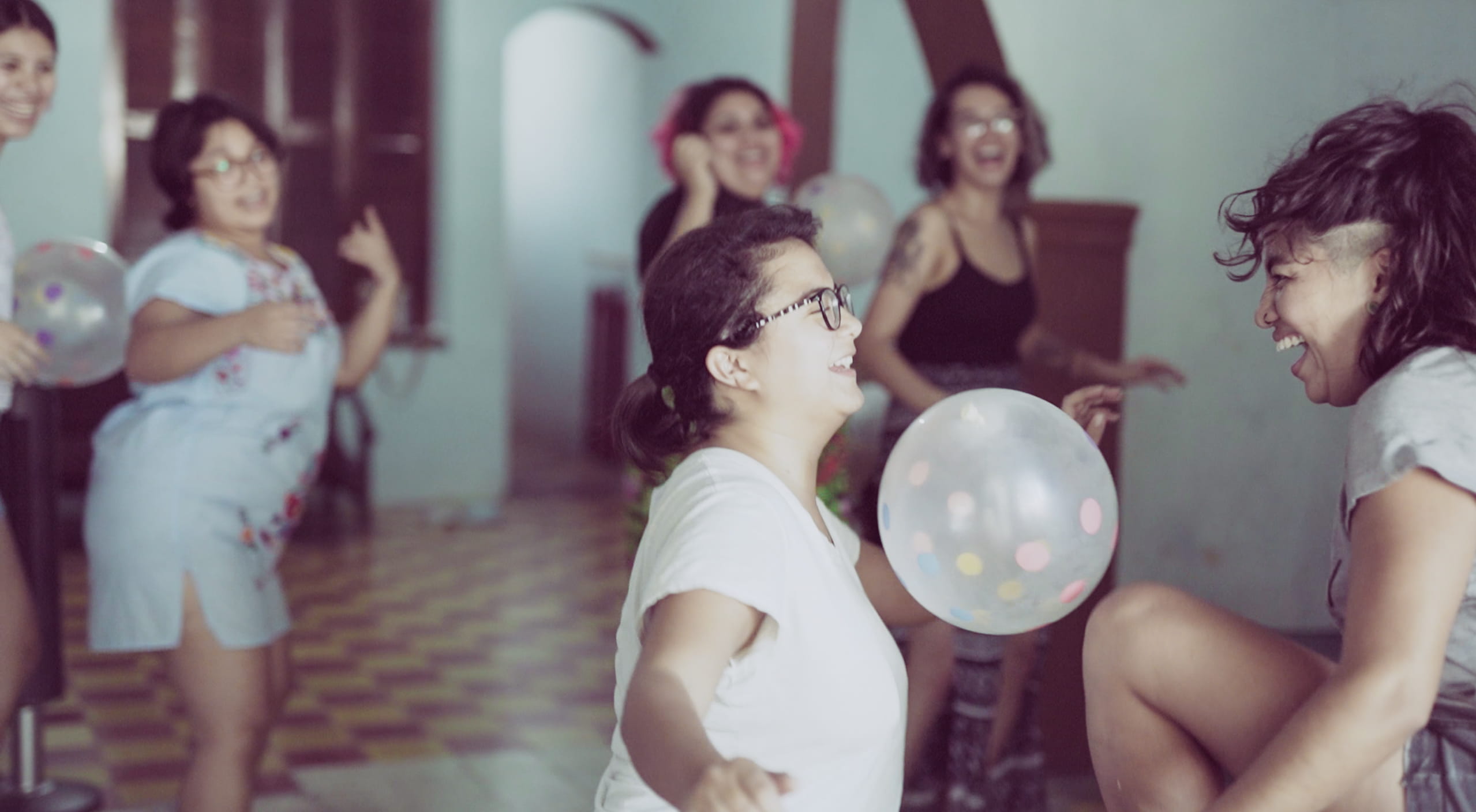
During RecrearMagnify 2016 in Colombia, we were graced with the presence of Elissa Marshall, an awe-inspiring dancer, yogi and all around great person (see what she is up to on Instagram!). For the last five years, Elissa had worked at El Colegio del Cuerpo (Cartagena de Indias, Colombia), a community space created for youth to approach the expressive and artistic dimension of the human body, through Contemporary Dance. Elissa was tasked with facilitating our intercultural group through a 3-day personal development course. People were either excited or terrified about having to dance – even asking themselves ‘what does this have to do with participatory action research and collective practice?’. So we were pleasantly surprised when one exercise after another challenged us to connect to one another in entirely unexpected ways. One of these exercises is what we dubbed ‘balloon mirroring’.
We have since reused this exercise during our Participatory Action Research trainings and broader accompaniment processes. We were surprised to see how beautifully people interpreted the meaning of that exercise for them. It was about coming into harmony with others, they said. It was about deep listening – the kind that goes beyond words.
We’re exploring what it means to get on the same page with others and what kinds of obstacles get in the way of that.
Through this exercise, we want to underline the importance of getting in sync with people energetically so we can more easily lean into the important conversations later. There is value in taking the time to observe one another and land into the space together before we launch into in-depth conversations. When we're doing research, this means finding the time to come closer to one another before probing with more technical activities and questions.
Blow up some balloons, make sure there is enough balloons so that if your group is divided into pairs, each pair can have their own balloon.
Get people into pairs and give each pair a balloon.
Each pair assigns an A and B person. Tell A their only task is to dance with the balloon to the music. They cannot hold the balloon between their hands but they must always maintain contact with it. Meanwhile Bs are instructed to try and mimic the movements of A as gracefully and in harmony as possible. They should try not to look directly at A but rather, glimpse them from the corner of their eye as they move. This is a dance after all!
Play music for about 2 minutes. Then ask them to switch roles. You can change up the music in each round.
After they’ve had some practice, you can ask for three pairs to do the exercise in front of the rest of the group while the others observe.
Repeat so that everybody has the chance to perform.
Debrief on the experience. You might ask:
You might want follow this exercise with an exercise/reflection on active listening.
It’s a great way to build people’s confidence and trust around one another. It also challenges us to use our bodies as part of the way we engage in deep listening. In Participatory Action Research this looks like going beyond listening for ‘ideas’ but also tapping into your ability to perceive others and respond to what is emerging.
Since it’s dance, it can be uncomfortable for some people. It also might be more challenging in an environment where there are people with disabilities or older people (that being said we had a 60 year old rock it in our last course!). If there are disabilities involved, include rolling chairs or other items.
You can use this exercise simply as a fun icebreaker! Never doubt the power of an ice breaker when its well done. Participants in our workshops often refer to this as the ‘magic’ that makes it possible to do the often-times difficult collaborative work – especially when are working with diverse groups with opposing ideas.
Picking fun and dynamic music is part of what makes this exercise work. So pre-select your songs beforehand. If you want a recommendation, one of our personal favorites is Gbadolite.